Friday, December 12, 2014

Pioneer SP-BS22-LR Speakers

Introduction


There is a high chance you would have heard of the SP-BS22-LR speaker - this speaker has been creating a lot of buzz since it's release.

Designed by Andrew Jones (who spends most of his time designing the delectable TAD speakers), the SP-BS22-LR is a compact 2-way bookshelf speaker. The woofer is a 4 inch structured surface woofer, while the 1 inch fabric tweeter handles high frequencies. This is a bass-reflex design, with the port located on the rear of the speaker.


Nominal impedance is stated as 6 ohms, and sensitivity at 85 db. Frequency response is listed as 55 Hz - 20 kHz (no limits stated).

5 way binding posts are provided, and the crossover is specified as a 6 element crossover. Looking at the photos of the crossover on the internet, this appears to consist of 2 sandcast resistors, one air core inductor, one iron core inductor, one plastic capacitor and one electrolytic capacitor.

Physically, the Pioneer is well built with the boat shaped MDF enclosure feeling solid and much better than suggested by it's price tag.

This is a small speaker, with dimensions of 7 1/8 " (W) by 12 9/16 " (height) and 8 7/16 " (depth) and a weight of 9 lbs and 2 oz each. For the metricised world, that is approximately 18 cm x 32 cm x 21 cm and 4.14 kg.

Coming back to the price tag, this speaker retails for the shockingly low figure of USD 129 per pair. If that is not enough to floor you, do be aware that this speaker regularly sells for far less than that, with Amazon offering these speakers a shade below USD 60 when it is feeling especially generous. Based on the bill of materials in this speaker, I am not too sure how Pioneer makes any money on this, especially after taking into account distribution costs and the like.

Herein lies the biggest problem with this speaker - it sells for SGD 399 in Singapore. This becomes a problem for reasons that will be explained later.

Sound Quality

I set up the Pioneer on my partially filled Partington Dreadnought Broadside 24 " speaker stands. The ideal position ended up with the speakers about 6 feet apart, and 2 1/2 feet from the back wall. The speakers were toed-in, firing almost directly at my ears.

The Pioneer was paired with my Gryphon Diablo integrated amp, and hooked up with Acrolink 7N-S1400III speaker cables. The source was my Antelope Zodiac Gold DAC, fed either with a Oppo 103D, or a Mac mini. 

Admittedly, the partnering equipment is not representative at all of what the Pioneer will be used with, but I wanted to see how well the Pioneer could perform, without having to second guess whether the rest of the chain was holding it back.

The Pioneer was fresh from the box, and I gave it a burn-in of 48 hours at fairly low volume, and then a further 3-4 hours at higher than average volumes.

Listening to a variety of music, I was struck by the quantity of bass produced by these tiny speakers. They had a full and warm bass, and sounded much larger than suggested by physical dimensions or driver cone size. Turning up the volume didn't faze these speakers one bit. On the contrary, they really came alive at louder than average volumes.

The grills darkened the sound noticeably, and I did most of my listening with the grills off.

Midrange was smooth and pleasant. This helped temper harsh recordings but smoothed over microdetail such as the vocalist's breathing or subtle voice texture. There was also an occasional touch of nasality, but this was very much dependent on the recording.

I found the treble to be a bit recessed. The information was all there, but with less prominence and presence. On drumwork, the Pioneer emphasized the kick-drum, rather than the cymbals. 

Detail wise, this is a big picture speaker. As an example, Double Bass could be felt and heard, but without the definition of the strings and resonance from the body of the instrument. 

Imaging and staging were done reasonably well, although by absolute standards, soundstage depth was a bit lacking, and imaging specificity could be better.

Moving away from absolute performance, these speakers were a lot of fun to listen to. They sounded big and pleasant, and took a good stab at a wide genre of music. From a value perspective, these speakers are excellent. I can see a lot of these being used in small bedroom setups, or as a replacement to the afterthought speakers supplied with most micro component systems. They certainly hold their own and would likely be competitive with most speakers below USD 250. 

Based on the local price of SGD 399 (that is about USD 300 at time of writing), the value proposition becomes less compelling. You could do a lot worse, but the Pioneer ends up competing with a lot of other attractive options, such as the Usher S-520, or the Monitor Audio BX2 for just a little bit more money. The Usher does sound a lot leaner than the Pioneer, but both the Usher and Monitor Audio have the edge in terms of detail, staging and overall refinement.  

Conclusion

The Pioneer is certainly the finest speaker I have heard below USD 150. However, it is far from perfect, and not the answer to all speaker problems in life.

It is definitely a slam dunk at the prices offered in the United States, but purchasers should be realistic and reasonable as to the performance of these speakers. At local prices, it becomes a bit of a tough call. 
 
The review sample was kindly loaned by Chris L. Thanks Chris ! 


Thursday, October 30, 2014

Sony MAP-S1 Multi Audio Player System and SS-HW1 Speakers

Introduction

The Sony MAP-S1 is a compact all-singing and dancing micro component system. 


As tiny as they come - the MAP-S1 is nevertheless functionally fully loaded.


The MAP-S1 consists of a 50 watt per channel (into 4 ohms loads) receiver integrated with a front loading CD slot. The built in DAC is capable of decoding high resolution audio files of up to 24 bit resolution and a sampling rate of 192 kHz. 

Input flexibility is excellent with a front panel high current (2.1 A) type A USB port for thumb drives / hard drives and a rear type B USB port for connection to a computer. DLNA support is provided via Wi-Fi or ethernet. All major file formats are supported, including DSD. Airplay and Bluetooth are also supported. On the analogue front, a pair of line level input and output jacks are also provided. 

The lacquer finish on the SS-HW1 is good enough to pass off as fine furniture.

A close-up shot of the top-mounted super tweeter.

Rear facing port and 5 way binding posts.
The SS-HW1 is a small bookshelf speaker, sporting 4 drive units, in a 3-way reflex loaded design. The drive complement consists of a 13 cm mica loaded woofer, a 25 mm soft dome tweeter, and a pair of 19 mm super tweeters. One of the super tweeters is forward firing, and the other unit fires upward.

Specifications wise, the SS-HW1 has a rated frequency response of 50 Hz - 50 kHz (no limits stated), 4 ohm nominal impedance and 83db sensitivity. Compared to it's peers, the SS-HW1 could be considered to be an inefficient and difficult to drive load. 

A detachable grill is provided, although in a rather daring move, the top mounter super tweeter is left fully exposed. I certainly hope Sony has a large stock of super tweeters on hand - itchy fingers are bound to result in a lot of dented units.

The reflex port is located on the rear of the speaker, together with a single pair of 5-way binding posts. The circular shape of the terminal block may present a bit of difficulty if your speaker cables are terminated with large spades.

The SS-HW1 is 171mm wide, 273 mm deep and 309 mm tall. A single speaker weighs in at 5.1 kg. 


Operation

Using the MAP-S1 out of the box was not too difficult. In fact, most of my time was spent removing the plastic inserts out of the speaker binding posts in order to use my banana plug terminated speaker cables.

Accessing the unit's functions via the various buttons and knobs on the front panel was a bit fiddly. It was far more efficient to download the recommended Sony app, "SongPal". Once I had the app running on my iPhone, I connected my phone to the MAP-S1 via Bluetooth. The app then prompted exporting the wireless settings of my home network to the MAP-S1, and established a connection within seconds. SongPal supports Deezer, and internet radio via TuneIn. SongPal definitely gets top marks from me for ease-of-use and stability. 


For purposes of this review, I set up the SS-HW1 on 24 inch tall Partington Dreadnought Broadside stands, with the speakers placed about 6 feet apart, and well away from the side and back walls. The speakers were toed-in with the speakers firing to a point a few feet behind me.

Although speaker cable was supplied, I used a 2.5 m pair of Acrolink 7N-S14000III speaker cables terminated with Oyaide SRBN banana plugs.

I tried the various inputs, but for most of this review, I settled for playback via CD, or feeding the MAP-S1 via USB from my Macmini running Pure Music software.

Sound Quality

Paired with the SS-HW1, the MAP-S1 exceeded my expectations given the high feature count and modest price tag.

The SS-HW1 produced a full mid-bass, smooth midrange and an airy top end. Mid to high frequencies showed a bit of restraint, with a slight emphasis on very highest frequencies. On classical music, this translates to sweeter and fuller than usual violin tone, with an increased sense of ambience of the recording venue. 

The Sony speakers also had no issues casting a wide and moderately deep soundstage with a good sense of image height (courtesy of the top mounted super tweeter ?). Image sizes were slightly larger than usual. The listening sweet spot was also generously large, and you probably won't need to fight with other family members for the best seat in the house. 

Resolving power is above average, although the SS-HW1 can be best described as a speaker with a "big-picture" perspective. There is some smoothing over of detail, but this can be quite useful in taming "hot" and poor quality recordings.

Any other downsides ? I noticed a bit of mid-bass colouration especially at louder levels (cabinet resonance perhaps ?). I also found that the SS-HW1 sounded better on smaller scale music like acoustic jazz, female vocals, chamber music, etc. The bass response on the SS-HW1 showed some signs of congestion on louder and fast types of music.   

Although I had some reservations about the ability of the MAP-S1 to drive a difficult load such as the SS-HW1, the combination seemed fine, with sufficient power and control at typical domestic listening levels. 

To further evaluate the quality of the SS-HW1, I hooked them up to my personal equipment, a Gryphon Diablo integrated amp paired with an Antelope Audio Zodiac Gold DAC. 

The generous power on tap (the Gryphon is rated for 500 watts per channel into 4 ohm loads) and grip really helped to keep the bass performance of the SS-HW1 under control. The Antelope / Gryphon lifted the performance of the SS-HW1, with a healthy increase in bass grip, speed, dynamics, staging confidence and overall resolution. 

Conclusion

I really think that Sony got it right with the MAP-S1. It sounds good, and it's internet / network play capabilities offer great flexibility. Performance wise, it punches well above its weight, especially for its asking price. I would highly recommend the MAP-S1 for the budding audiophile, or anyone who is looking for a compact and good sounding all-in-one component.

The SS-HW1 sounds good with the MAP-S1, and it is nice to know that these tiny speakers can grow together with any system upgrades. They are more expensive that I would have liked, but are otherwise a competent performer in a superbly finished package. I found it easy to overlook it's shortcomings and enjoyed it's rich and pleasing reproduction of music.

The recommended consumer price for the MAP-S1 is S$ 1,199, and S$ 999 for the SS-HW1.

I would like to thank Sony Singapore for supplying the review unit, and it's media partner Waggener Edstrom for making all the necessary arrangements.  

Wednesday, October 29, 2014

AVM (Audio Video Manufaktur) - Udo Besser visits Singapore

Introduction

I confess to having little knowledge about AVM prior to attending this event. A quick flurry of research unearthed some interesting facts about AVM. It has quite a long history, and it's present owner, Mr. Udo Besser has an established track record in the audio industry, being formerly CEO of the well known German high end audio company, Burmester.

Browsing through AVM's website, the impression conveyed was that of elegantly designed products catering to a wide range of customers - from the beginner to the very serious enthusiast.

Products

AVM's exclusive dealer in Singapore, Sound Decisions had arranged for Udo to meet some of it's customers and members of the hi-fi press at it's cosy showroom.

A number of products had been set-up for demonstration including the SD 5.2 Streaming DAC from AVM's Evolution line of products, and the PA8 modular preamp and MA8.2 monoblock amplifiers from it's top range - the Ovation line.

Also on display was a line-up of all-in-one solutions (CD, DAC, tuner, and amplifier - just add speakers !).


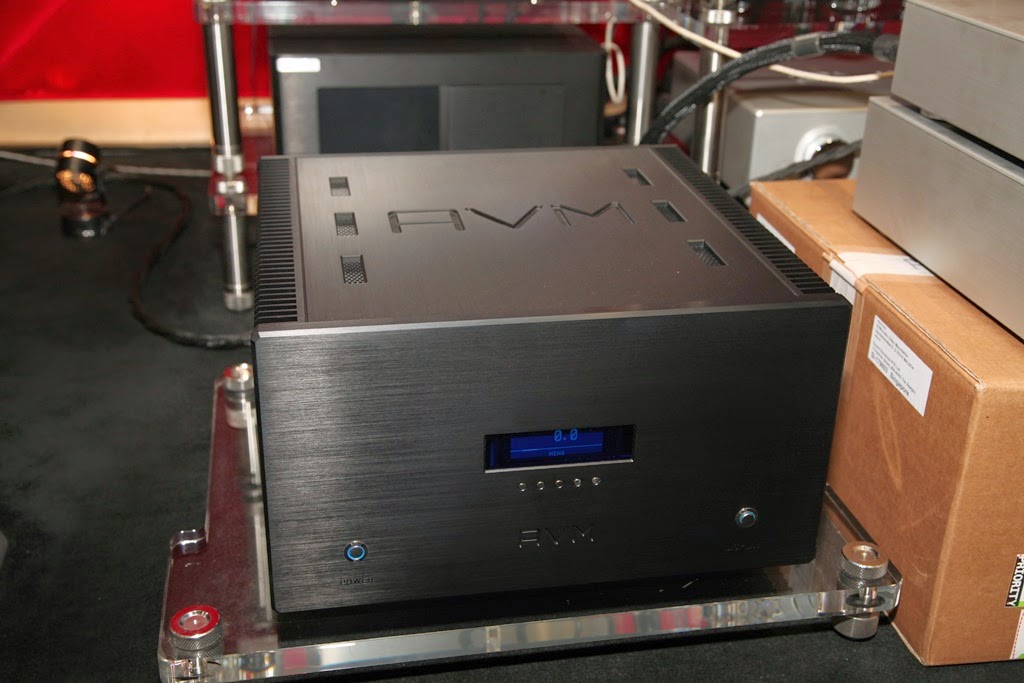
The mighty Ovation MA8.2 mono power amplifier.


From top to bottom :- Inspiration C8 CD-Receiver, Evolution SD5.2 Streaming DAC, Evolution C9 CD Receiver. 

Attendees were shown how the SD5.2 could be operated, both using the supplied radio frequency remote control, and with an iPhone running AVM's iOS app (under development). The remote control and the iPhone were able to simultaneously control the SD5.2 seamlessly - selecting tracks from the connected NAS, or from music files stored on the iPhone. It was even possible to power up and power down the system. 


Udo then made a short presentation on AVM, with a description of the different product lines. 


Some points of interest :-

1. AVM manufactures it's products in Malsch, Germany.

2. The vacuum tubes used in it's products are custom designed and manufactured specifically for AVM and then screened and tested for quality by the tube manufacturer.

3. The mono output boards in the Ovation series power amplifier are fed separately by a small dedicated toroidal transformer for each individual board, instead of the common industry practice of using a single massive transformer with multiple voltage taps. 

4. AVM uses UcD Hypex amplifier modules specially customised for AVM in its entry and mid level product lines.

5. Custom finishes are available at extra cost including a stunningly beautiful mirrored chrome finish (I couldn't help but mention this to whet the appetite of all you Burmester fans out there).

I was impressed by the build quality of the products on display, coupled with reasonable pricing. I especially liked the tactile feel in operation of the knobs and switches, and the elegant designs that exuded class.

A close-up of the tube output board, with the custom specified and manufactured tubes.

You can definitely put my name down for the optional chrome finish.


Udo in Conversation

I asked Udo whether he designed his products with a certain philosophy in mind. His answer was that sound quality is his most important objective. Any particular technical design choice would be made based on this. As an example, he cited amplifier power - the end objective was not to make the most powerful amplifier available, but high power output (e.g. in the Ovation series amplifiers) was a by-product of pursuing that objective.

We also discussed the choice of a switched mode power supply in the PA8 preamplifier, which is generally frown upon by audiophiles.  Again, Udo stressed that the best power supply design was chosen for the task, and in this case, a switched mode power supply best achieved his objectives, and  was critical to ensuring low noise in the optional phono stage card.

I was interested to know more about the modularity offered by the PA8 (e.g. choices available include a DAC card, phono stage, tuner card, and a tubed output stage) - did he feel that this would cause interference or somehow degrade performance ? Udo explained how these issues were overcome in the design (the cards are shut down if not required, and powered up again when necessary) , and that simply, he would not launch any product unless it met his exacting standards. Much thought also seems to have been made on the software front, with the PA8's firmware checking each individually installed board. A newer version board installed would automatically update the unit's firmware - very smart indeed.

Sound Quality

Crowds make it quite hard to evaluate sound quality. I cheated somewhat and had a quick audition of the PA8 and the MA8.2 a day prior to the event. I was not familiar with the German Physik paired with the PA8 and MA8.2, but the tone of the system was on the fuller and sweet side. The system at all times sounded natural and effortless (600 watts per channel (into 8 ohms) - power does corrupt !), with excellent bass depth and definition, and spades of detail across the frequency spectrum. I am pretty sure these could hold their own against the rest of the premium names out there.

Conclusion 

Looking at the clean design lines, excellent finish, and ease of operation, you have on hand a product that has purposeful objectives achieved by solid engineering. In that vein, AVM is the epitome of Teutonic values.    
  
AVM may be a relatively new kid on the block internationally, but I would give them serious consideration - whether you are looking for a good-looking all-in-one system, or top drawer electronics.

I would like to thank Sammy and Eugene of Sound Decisions for inviting me for this event.

Sound Decisions

1 Coleman Street
#04-49/62 The Adelphi

Singapore 179803

Tel: (65)6733 8227
Fax: (65)6733 8229


www.sounddecisions.com.sg