Sunday, January 20, 2013

Clash of the Titans - Acoustic Revive RR-777 vs. Telos Quantum Acoustics Diffuser / Alpha Wave Generator

Introduction


Schumann Frequency vs Alpha Waves ?

Many readers would have heard of the product that started it all, the Acoustic Revive RR-77. Acoustic Revive has recently replaced the RR-77 with the RR-777. Appearing physically similar to its predecessor, the RR-777 promises an improved circuit which boasts a generator that is four times more powerful. Both generate a Schumann Frequency pulse, at 7.83 Hz.

Supplied with a switching mode power supply, and a very long DC cable, Acoustic Revive advises that the RR-777 be kept away from other components and be placed at a height of at least 1.5 m. The main unit is made out of plastic, and sports a rocker switch behind, to turn the unit on and off. A single blue LED on the front of the device indicates operation. The LED is bright enough to upset audiophiles used to bat-cave like conditions, but it is not bright enough to be used as a night light !

The light weight of the device makes it perch a bit precariously in high places, and perhaps a bit of blu-tak should be used to secure it down safely.

A single blue LED adorns the front of the Acoustic Revive 777
Rear view - DC jack and a rocker switch for power
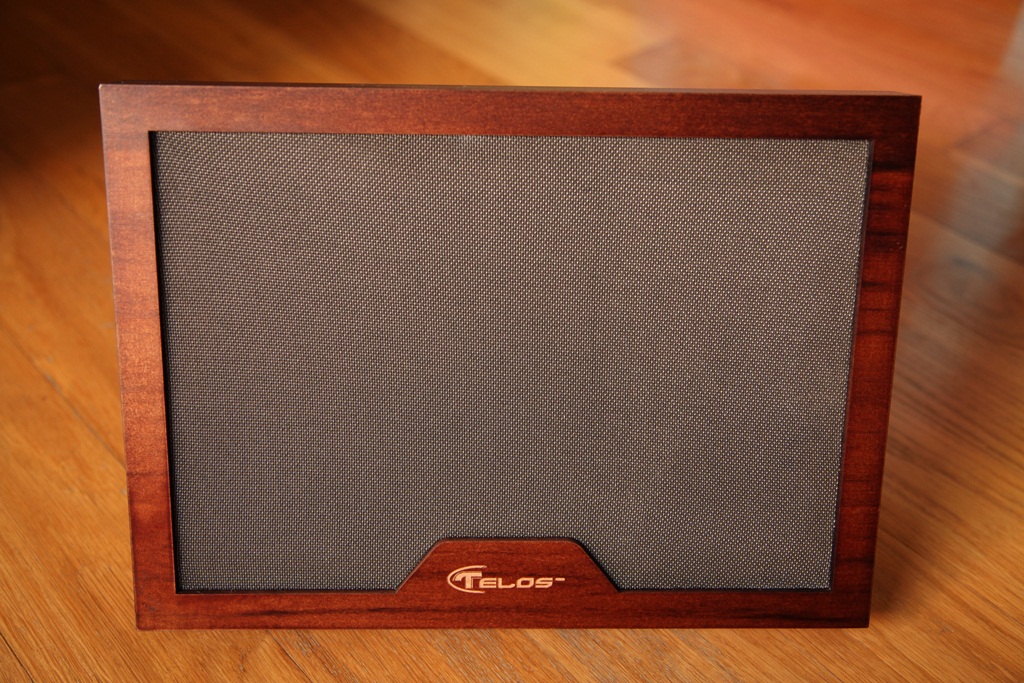
The Telos Quantum Acoustics Diffuser on the other hand operates at a higher frequency, at 9.41 Hz (based on unconfirmed information) and is fashioned more like a picture frame. I happened to see its internal circuit board at the local Telos dealer, and much of its area is dominated by its antenna. The Telos has drilled holes  to support wall mounting, and includes a screw-on wooden leg to allow it to stand like a table top picture frame.
Finished nicely in wood trim, just like a photo frame

The battery bay at the rear takes in 4 AA batteries. The wooden rod seen at the bottom of the picture screws into a small threaded hole to allow the Telos to balance upright.
The PCB of the Alpha Wave
The supplied switch mode power supply looks similar to the Acoustic Revive supplied model, but operates at 9V DC, instead of the 12V DC used by Acoustic Revive.

The green LED light that indicates operation is near invisible in daylight, and does not call much attention to itself, even in pitch darkness. Uniquely, the Telos allows battery operation via 4 AA batteries that fit into a battery compartment on the rear of the unit. A second red LED light indicates a weak battery. The Telos does not have any charging circuit built in, so the rechargeable battery crowd will need a separate charger.

One criticism against the Telos would be the position of its DC socket. Its location makes the use of a right angled DC plug mandatory. Users with aspirations of using upgraded power supplies may need to do a little bit more leg work to find a suitable plug. On the feature count, the Telos edges ahead of the RR-777 given its battery option.

Officially, no placement tips are given, although the local dealer advises that the Telos is not particularly sensitive to placement. Nevertheless, for comparison purposes, both were placed behind my left speaker, perched at a height of approximately 1.5 m.

A group shot shows the relative size of the two unit on test.

Sound Quality

Both units were tested after a few weeks of usage, and were initially used with their stock power supplies.

The RR-777 is characterised by a focused and detailed presentation. Midrange images are presented in a pin-point fashion, with detailed texture and decay. Both voices and instruments have relatively small image sizes. This quality is applied evenly to high frequencies, giving systems a slight lift and extension there, with enhanced air and edge definition.

Flute solos have noticeably more air, while finger work and sliding on acoustic guitar strings are more distinct and precise.

Soundstaging is slightly distant, with a movement of the soundstage at least a few rows backwards, helping to  create the illusion of depth.

Bass is relatively unaffected by the RR-777, although it would appear that there is a very slight reduction in impact and speed.

Tonally, the RR-777 shifts systems towards a brighter and more brilliant presentation. I noticed on the downside that sibilance is worse on the usual problematic tracks.

Like its predecessor, the RR-777 can be tuned via its power supply. The stock switching unit is bright and crisp. Using a 2A linear power supply changed the RR-777 drastically, making its balance closer to that of the Telos. Besides a heft and roundness to bass notes, the linear power supply resulted in a richer and bigger voice, with a slight forward shift in the soundstage. Unfortunately, there was a slight loss of high frequency extension. Hooking up a  3A switched mode power supply which happened to be lying around, the RR-777 took on a middle ground between the stock switcher and the linear power supply.

Readers would need to consider whether the power supplies were directly affecting the performance of the unit, affecting the power line via radiated noise, or a combination of both. To minimise variables, the stock switching power supply was left plugged in at all times, while the alternative power supplies were being used.

Next, we take a look at the Telos. Like the RR-777, the Telos enhances acoustic space, and results in a more detailed and textured presentation of voices and instrument. The Telos presents the human voice with a richer and smoother tone. Image sizes are larger, and similar to the RR-777, the soundstage is more distant compared to stock.

High frequencies are extended, although this is done in a natural and subtle way.

Dynamically, the Telos has more authority, with an increase in mid-bass bloom and low bass extension. Timing wise, it gives music more PRAT.

Evaluations of the Telos with different power sources would be more difficult, given that 9V power supplies are not as common. However, I recently procured a 9V Kingrex PSU Mk II to explore power supply improvements. Like the RR-777, the Telos proved sensitive to the power supply. The Kingrex added additional weight and slam over the stock power unit. However, I found that the effect was a little bit overpowering and preferred the faster and snappier sound of the stock power supply.

Comparisons

Either of the units above used in isolation offer a significant improvement in sound quality. As a matter of tweaks, the change is as significant as changing your source or amplifier. This would apply even in high-end, and highly tweaked setups. The rationale for the efficacy is difficult to comprehend. Should a small device that sits outside the signal chain  make such a difference ?

Unlike most tweaks and modifications, these units presumably work on the listener rather than the system hardware. A quick internet search on the Schumann Resonance and Alpha Waves will yield many pages of interesting reading.

Since these units work on the listener, the effect on each person varies. I demonstrated both units to five other audiophiles. The first person had significantly different observations (e.g. I would perceive increased bass, or a richer sound while he would hear the opposite thing). He also had physical sensitivity to both units, with an uncomfortable feeling of pressure in his head whenever either units were used. Two other persons did not feel any discomfort and their observations on the differences were quite consistent with mine. Personally, I did feel a slight tingling sensation in my fingers with either unit in operation, but the feeling was not uncomfortable. Two of the other listeners did not feel that the differences were discernible or significant.

Both units increased the feeling of spaciousness and improved the depth and width of the soundstage. They were also consistent in increasing resolution, extension and decay.

The main difference between the two units are in their overall tonal balance and presentation. The Telos is warmer and more laidback. It has more mid-bass bloom, not unlike a good tube amp. The RR-777 is brighter and more analytical, especially with its stock power supply.

In my system and given my musical taste, I preferred the Telos. I can well imagine that some may prefer the tone and presentation of the RR-777.

I tried both the Telos and RR-777 simultaneously. Interestingly, both units are able to co-existing peacefully, with the result being a combination of strengths of both. However, over the long term, I felt that the midrange coherence was lost - an expected result since this was an area of divergence between the two units.

Conclusions

System matching is everything, and your choice of either one would depend on the result that you are trying to achieve. I was suitably impressed with both units and can highly recommend both. However, given its dependency on the listener, you should try before you buy.

Friday, November 2, 2012

International Sound & Sight Exhibition 2012

It's that time of the year again - for Singapore's major hi-fi show, International Sound  & Sight Exhibition (ISSE for short).

Being somewhat crowd adverse, I paid a visit on the first day of ISSE, which would be less crowded, being a Friday.

The reception level contained the larger exhibition halls, with the bigger systems usually setup in larger acoustic spaces.


First visit was to High End Research's room.

The Wilson Audio Alexia standing guard over the Pass Lab monoblocks
Wilson Audio's Alexia was being driven by Pass Lab monoblocks paired with an Audio Research Reference 10 preamplifier. The source was a Mac computer, feeding an EMM Labs DAC. In fact, quite a number of exhibitors were showcasing computer audio based setups.

The system was being played a bit too loud for my liking, with the usual hi-fi demonstration type of tracks. It was very dynamic and incisive, perhaps a bit too much so for my taste.

As it was close to a scheduled live performance, I made a detour for Z Yan's live performance.


She has a lovely rich voice that belies her petite frame. Her bossa nova style of singing in Chinese is quite unique. I truly enjoyed the experience, and picked up a copy of her CD on the way out.

Back to the lobby rooms for a quick look-see.

Voxativ speakers with an analogue front end


The TAD speakers were playing some choral music when I walked in, and the purity of tone and effortless reproduction was breath taking. Some other tracks were not so convincing, and the simpler types of music fared better in my short time there.

Going off to the 7th floor, where the smaller exhibition rooms were, I was impressed by the more consistent quality of the systems compared to past shows, where exhibitors persistently showcased large speakers that overwhelmed the acoustic space of the tight hotel rooms.

Poon of Horizon Acoustics gamely posing for a photo

Amplification duties handled by Modwright

Source duties handled by an Ayon CD player fed into an Antelope DAC. The Resonessence Labs Invicta DAC on the right was not playing when I was in the room.
The Nola speakers in Horizon Acoustic's room were performing well and left a good starting impression for me as I started my tour of the seventh floor.

Sky Audio - ALR Jordan speakers, D & T electronics and a Macbook playing computer audio
Sky Audio's room get's honourable mention for most surprising system. The D & T amplifiers were only rated at 60 watts per channel. Somehow, the ALR conveniently forgot that it was a small speaker and sounded big with more bass than it's dimunitive size would suggest. Steve Sai shared with me some of his views on tweaking, as well as the principles behind the latest version of his self-built range of cabling.

ASI electronics and Entreq power distributor and ground conditioner. Speakers are aliens from a far away planet standing very still and hoping to blend into the environment.
Sound Decisions - Da Vinci DAC, Electrocompaniet amplification and Thiel CS 2.7 speakers
Sound Decisions was demonstrating the brand new Thiel CS 2.7, which sounded significantly better than the CS 2.4 as well as I remember.Sammy Low, principal of Sound Decisions admonished me gently for not visiting for a while. In typical Thiel fashion, the 2.7 was clean, detailed, and simply passing on the message from upstream components. Sound Decisions is an official distributor of Stressless recliners that seemed to captivate many a listener, some of which ended up seemingly stuck to the chair on a molecular level.

X Audio - Brodmann speakers matched with MSB DAC and Octave amplification.

X Audio's second room - Accustic Arts electronics with Brodmann speakers.
Audio Basic - Aurelia speakers with the Calyx Femto DAC paired with Trigon electronics.

Steven Cheah of Audio Basic posing with the Aurelia Cerica. Perched behind, on the shelf is the Telos Alpha Wave generator.
Audio Basic had a very nicely tuned system with the Aurelia Cerica sounding excellent - far better than the previous two occasions I head them at Audio Basic's showroom. Steven also demonstrated the just launched Telos Alpha Wave generator. The crowd was suitably impressed, with a flattening of perspectives, and the soundstage moving forward and shrinking each time the Alpha Wave generator was switched off.

Some other very good sounding setups were also heard, with the Verity Audio speakers impressing with its excellent level of detail and naturalness.

Unfortunately, a scheduled appointment meant that I could not spend time listening to all the systems in detail, and I wrapped things up after 2 and a half hours at ISSE.

Sunday, September 23, 2012

Aurelia Cerica - Quick Impressions

The first things that strikes you about the Aurelia Cerica is its unusual looks.Unlike most speakers, the Aurelia is slim and quite attractive to the eye - both for the Audiophile and the unafflicted. The sample I saw one early afternoon at the local dealer was finished in gloss white.

The next thing you will notice is its unusual driver arrangement, which has a symmetrical array of two mid-bass units flanking a cluster of three tweeters. The tweeters appeared to be recessed in a shallow wave guide.

On the rear panel of the speakers,are a single pair of high quality binding terminals, and a presence switch. The dealer explained that this controlled the high frequency output, with the "hi" position recommended for tube amplification, and the "lo" position for solid state systems.


Firing up the Cerica, the immediate impression is one of both coherence and immediacy. The full range driver crowd will feel right at home here. The second thing that impresses is the size of the speaker's imaging and soundstaging.

The Cerica has a very "live" and fast sound, and is quite different from the typical audiophile speaker which sounds more damped, and drier. Vocals take center stage, with a big emphasis on vocal texture and inflection. Listeners who like their vocals presented with laser focused precision are advised to look elsewhere. Music is presented with a very big and dynamic feel, more akin to a live performance, compared to listening to a recording over studio monitors.

Detail retrieval is excellent, with low level spatial clues coming across clearly. High frequencies are "wetter" than normal, with a strong emphasis on reproduction of acoustic space. I felt that its presentation was a little bit too bright, which could be an issue with partnering equipment - I heard them driven by a full set of Trigon electronics. Perhaps, a longer audition with softer sounding equipment is in order.

The Cerica has limited bass though, with no sonic illusions that the Cerica is a bookshelf speaker. Fortunately, the limited bass on offer is at all times, fast, tuneful and tight.

In conclusion, the Cerica is quite different in its presentation from the typical audiophile speaker, and may not suit all taste. However, listeners who demand a lively, dynamic and detailed speaker, with looks that need no excuses are well advised to give the Cerica a serious audition. In gloss white, the Cerica would blend in perfectly in modern styled homes.

Pricing is also competitive. My guesstimate of the Cerica's price pleasantly turned out to be more than 30 % off the mark.

Part Two

A week after the initial audition, I returned to the dealer who had re-positioned the speaker as well as the spare equipment around it. It happened to be playing when I dropped by and I immediately noticed that the speaker sounded totally different from my first audition.

The speaker sounded neutral, without any hint of brightness which I experienced earlier. The partnering equipment was identical - looks like this speaker requires a bit of setup to make it sing. Bass output was much more, far more than its cabinet size would suggest. On the downside, I felt that the immediacy and vibrancy was better the first time round.

Part Three

I just heard this at the International Sight and Sound Exhibition 2012. It sounded really great in the small hotel room, with both deep, extended bass, and an immediate midrange coupled with extended high frequencies. In fact, the Cerica sounded much better compared to the earlier two occasions I listened to it.